Wednesday, 14 October 2015

1IB LISTENING - LANGUAGES

YOUNG NAVAJOS STUDY TO SAVE THEIR LANGUAGE


WORDS IN THIS STORY

promote - v. to help (something) happen, develop, or increase
robust - adj. strong and healthy
transmit - v. to give or pass (information, values, etc.) from one person to another
folks - n. people in general
principal - n. the person in charge of a public school
outcast - n. someone who is not accepted by other people
code - n. a set of letters, numbers, symbols, etc., that is used to secretly send messages to someone
inferior adj. of little or less importance or value
forefront - n. the most important part or position

​​_____________________________________________________________________________________________

SRIPT

For part of her life, Sylvia Jackson stopped speaking her native language, Navajo. Like many Native American children, she had little chance to speak her language.
“We had to speak English. So I lost a lot of just speaking the Navajo language.”
More than 100 years ago, the U.S. government began sending Native American children to boarding schools. All the instruction was in English. The native cultures and languages of the children were discouraged.
In the last 20 to 30 years, tribal governments have started to promote the teaching of Native American languages in schools. The U.S. Department of Education now also supports Native American language programs.
Today, Sylvia Jackson is a Navajo language instructor in the small town of Holbrook, Arizona. She teaches Navajo to students at Holbrook High School. Her class is taught entirely in Diné, the Navajo language.
Ms. Jackson said both she and her students have an important part in keeping their language alive.
“My parents are actually, they grew up speaking the Navajo language; they’re fluent speakers. They’re like a dictionary. If I ask them, “How do you say this?” they translate. But me, I’m learning as I’m going.”
Navajo Nation
​​The town of Holbrook is an hour by car from the Navajo Nation. The 69,000-square-kilometer territory is the largest of the 326 Indian reservations in the United States. The Navajo Nation covers parts of four states in the American Southwest. It is about the same size as the country of Ireland.
During the 1800s, increasing numbers of European settlers in America moved west. In 1864, the federal government began a campaign to deport Navajos from their lands. The natives were moved to the northwest in a series of marches called the "Long Walk." The marches took place under the threat of death.
Navajo leaders and the U.S. government reached a peace treaty in 1868. It established the Navajo Indian Reservation.
Today, more than 250,000 people live in the Navajo Nation. They have their own laws, fly their own flag, and elect their own president.
The 2010 United States Census showed that about 170,000 Navajos speak Navajo at home. It is one of the most robust Native American languages today.
A right to speak Navajo
But there is a growing worry that the Navajo language could disappear. Seventy years ago, nearly everyone on the Navajo reservation spoke Navajo as their first language. But today, few young Navajos can speak the language of their grandparents.
A study in 1998 found that only 30 percent of Navajos entering school spoke Navajo as their mother tongue. Just 30 years earlier, that was true of 90 percent of first-grade Navajo students.
Richard Epstein is a linguist and professor at Rutgers University in Camden, New Jersey. He said a language’s survival depends on one generation passing down knowledge to the next generation.
“In order to keep a language alive, the adults of the community have to be able to transmit it to the young folks.”
Dr. Epstein calls teaching and transmitting your native language to your children a right that should be better protected.
“Everybody should have the right to speak their own language, just as much as they should have the right to practice their religion. Because their language is as good as everybody else’s language…So if you take that away, you’ve taken away a massive resource for knowing something about a part of human life.
"And you’ve taken away a part of who those people are. Is that right? Everybody should have the right to speak their language and to transmit their language to their children and to keep their culture alive.”
​​On the reservation itself, Navajo language instruction in schools starts at a young age. At Indian Wells Elementary School, 3rd graders are learning how to read, write, and speak Navajo. The school opened in 2001.
Dr. Robbie Koerperich was Indian Wells’ first principal. Now, he is the superintendent of the Holbrook Unified School District. He said his district is concerned with preserving the Navajo language.
“The Navajo language itself, I believe, is a major concern on the reservation and in our district, pertaining to the preservation of the language. So the preservation of the Navajo language is part of our mission.”
Hortensia is a third-grader at Indian Wells Elementary. She said Navajo language is her favorite class.
“So we could learn it and teach it to other people.”
The role of older generations
Hortensia said she often visits her grandmother, or naali in Navajo. Grandparents on the reservation play an important part in passing down both the language and culture to their grandchildren.
Morgan is a Navajo language student at Holbrook High School. She is one of Sylvia Jackson’s students. She visits her grandparents’ home with her cousins, nieces and nephews. She said she sometimes feels like an outcast.
“With my nieces and nephews and my cousins, they’re about my age or a bit older and they don’t speak Navajo. And so it’s a bit hard when we go out to my grandparents’ place and they try to talk to us. And it feels like — when my grandparents and my parents talk together — I feel like, kind of like an outcast, like I don’t know what they’re saying, but it's like, I want to learn the language so I can carry it on and then teach my kids. And so we won’t lose the language.”
​​Some of these students’ grandparents and great-grandparents may also have played an important part in U.S. history. During World War II, the U.S. military recruited Navajo speakers. Together, they developed a code to send secret information past Japanese and German code-breakers.
The code was never broken.
Dr. Epstein credits the Navajo language’s complex structure for it being such a successful code.
“It was so unbelievably complicated that the enemy couldn’t figure out how it worked. And yet we took the children of these people away from their families to train them to speak English only on the grounds that this language wasinferior.”
Sylvia Jackson was once one of those children. Today, she finds herself at the forefront of keeping her language alive.
“If you just think about it, my parents, if they go, then that’s going to be me right there who has to carry that on. If I don’t have the knowledge that they had, that’s going to be it right there. So, I’m glad that we have students who want to learn the language, who want to keep that language.”
I’m Ashley Thompson.
And I’m Caty Weaver.
Ashley Thompson and Adam Brock wrote this story. Caty Weaver and Jill Robbins were the editors.


DEBATE QUESTIONS


- What do you think should be a priority language preservation or unifying people´s language worldwide?
- Do you think language, culture and identity go together or they are quite independent concepts?
- Do you think that some languages are more prestigious than others? Do you think this is right? 
- In Turkey Kurdish cannot be learnt in schools although many of them are native speakers born in mesopotamia.Turkish government forces them to learn only turkish in schools, they try to assimilate them and actually they succeed on this too. What do you think about this?
- Do you think that uniformity makes the world better or that it is variety what makes the world more interesting?
- Do you think that in order to preserve our culture is necessary to preserve languages
- Do you think goverments should be responsible to motivate the young generations to speake their native languages ? How? What arguments would you you to convince your son or daughter to speak kurdish for example?


Monday, 12 October 2015

LIMITS? WHAT FOR?


DO YOU WANT TO BE HAPPY?


ENGLISH IMMERSION FOR THE ESO!!


EE

5 DIAS DE INGLES Y AVENTURA - SECUNDARIA


A excepción de las actividades de Aventuras, que por motivos de seguridad serán en español, todas las actividades son en inglés.En total, este programa incluye:

PRECIODel 01/03/2016 al 30/06/2016Del 01/10/2016 al 29/02/2016
Todo incluidoTodo Incluido
5 DÍAS296 €267 €
Campus Moragete
Casas del Río - Requena
46356, Valencia - ESPAÑA
96 230 24 99 - 96 233 80 01
692 608 644
Fax. 96 230 33 90
info@campusmoragete.com
www.campusmoragete.com

Thursday, 24 September 2015

ORAL INTERACTIVE 4 IB INMIGRATION


Photojournalist Barat Ali Batoor was living in Afghanistan — until his risky work forced him to leave the country. But for Batoor, a member of a displaced ethnic group called the Hazara, moving home to Pakistan proved dangerous too. And finding a safer place wasn't as simple as buying a plane ticket. Instead, he was forced to pay a human smuggler, and join the deadly tidal wave of migrants seeking asylum by boat. He documents the harrowing ocean trip with powerful photographs.

Wednesday, 23 September 2015

ORAL INTERACTIVE 4 IB GENDER PREJUDICES


How would you react in a situation like this? 
Would you act in the same way?
Can you explain why this happens?
Do you think that when discrimmination affects men nobody really pays attention to it?


Yes, we all know it’s the right thing to do. But Michael Kimmel makes the surprising, funny, practical case for treating men and women equally in the workplace and at home. It’s not a zero-sum game, but a win-win that will result in more opportunity and more happiness for everybody.

Sunday, 20 September 2015

For the 1IB interactive oral, based on a listening resource for science and tech option.

Is BIG BROTHER already at our homes?
Are these all advantages of advance and technology?
What other questions come to mind when you watch this video?
Does technology always make our lives easier?

https://www.facebook.com/Arch2OMagazine/videos/887379071273454/?fref=nf

Artificial intelligence is getting smarter by leaps and bounds — within this century, research suggests, a computer AI could be as "smart" as a human being. And then, says Nick Bostrom, it will overtake us: "Machine intelligence is the last invention that humanity will ever need to make." A philosopher and technologist, Bostrom asks us to think hard about the world we're building right now, driven by thinking machines. Will our smart machines help to preserve humanity and our values — or will they have values of their own?

Wednesday, 24 June 2015

HOBBIES AND PASTIMES (B1 Course)

Recreation is important because it helps people relax. When people have fun they reduce their stress levels and improve their health. Healthy people are more productive. Types of recreation include: playing sports, visiting family members and friends, going to the zoo, enjoying the beach, and watching a movie. 

Having a hobby is a great way to relax and enjoy your free time, and spending time developing interests can also have many emotional, intellectual, and health benefits. Write a sample sentence for each word to learn how it is used in context. Use the Internet to find related information 


  1. bird watching
  2. coin collecting
  3. cooking
  4. dancing
  5. drawing
  6. gardening
  7. genealogy
  8. hiking
  9. knitting
  10. painting
  11. photography
  12. playing chess
  13. playing the piano
  14. pottery
  15. quilting
  16. reading
  17. scrapbooking
  18. stamp collecting
  19. surfing the Internet
  20. woodworking

Now, complete the sentences below with the best answer:
1. Laurie decided to take up _______________ as a hobby because she has always been fascinated with old money.A. knitting B. coin collecting C. dancing
2. I developed an interest in ____________ after my grandmother told me about our ancestors.
A. genealogy B. gardening C. cooking
3. Since she loves working with her hands and clay, __________ was the ideal hobby for her.
A. photography B. quilting C. pottery


IFollow-Up: Top
Search the Internet to find out more about two of the hobbies listed above. What supplies are needed for each hobby? Which hobbies are popular among teens, adults, and seniors?


Listening

Peter’s hobbies ; Melissa’ hobbies. Listen to these two audios and write your answers on this worksheet (year 5)
Free Time An interview with an 11-year-old. Vocabulary and Comprehension quizzes available
Things to do Choose an article to read and/or listen to
Listening Activity for Hobbies Vocabulary A challenging listening comprehension activity (year 6)

Watching

Alfy Goes Camping An interactive book to watch, read and play with online. Some may find childish. See below for more (year 5)
Top 5 Strangest Hobbies In The World (3:31) Just for the weird fun of it

Speaking

What do you do for fun? (3:22) Asking about hobbies, example dialogue phrases to practise
Hobby – Questions and Answers Learn different ways to ask and answer by listening to these sentences and make your own dialogues (year 6)
20 Conversation Questions to choose from for your class (year 6)

More Materials

11 Surprising Celebrity Hobbies Odd things famous people are into
Alfy’s Stories If your class enjoyed Alfy, here are some more stories
277 FREE ESL Hobbies printable worksheets, exercises to download and copy
ESL/EFL Teaching Resources Loads of pdf-worksheets
Which activities would you like to do? Explore new hobbies. A long list of ideas that pupils can find information about as a project

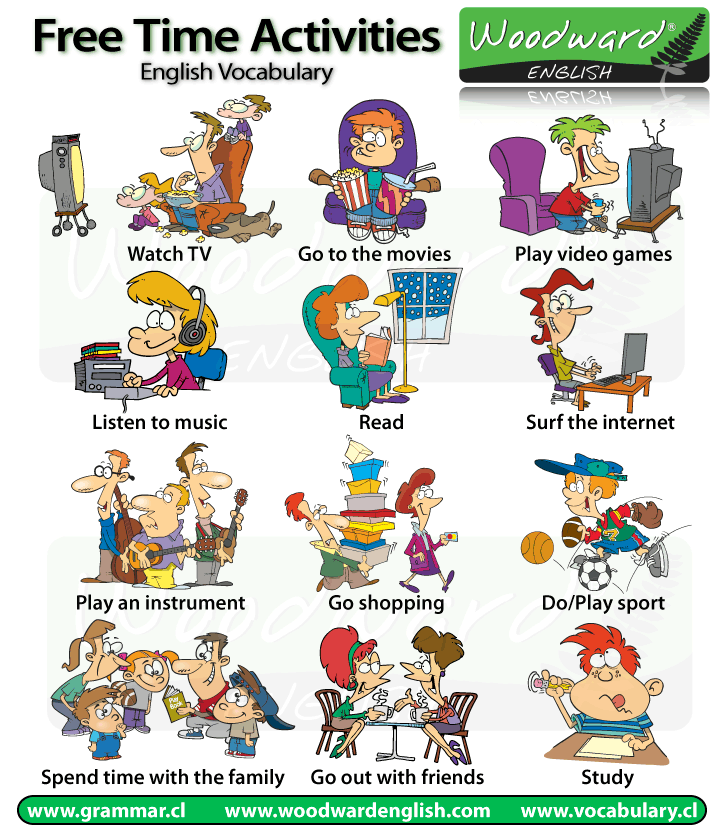
General Free Time Activities B1 Course

What do you do in your free time?


Go to the cinema - to see Hollywood blockbuster movies, Bollywood movies (from India), art films, animated films. You can also say go to the movies.
Some film categories are: Comedy, Drama, Horror, Thriller, Action, Science Fiction (Sci-Fi), Fantasy, Documentary, Musical.
Watch TV - Different types of television programs are: The News, Soap Operas, Criminal Investigation Dramas, Medical Dramas, Reality TV, Situation Comedies (Sit-Coms), Talk Shows, Documentaries, Cartoons, Game Shows, Sports programs, Movies, Political programs, Religious programs.
Spend time with family - You can do many things with your family. Usually, the fact that you are together is more important than the activity.
Go out with friends - You can also do many things with your friends, like go out to a bar, go dancing at a club, have dinner at a restaurant, play a sport, sit down and talk, go out for a coffee, have a barbecue, or any other activity that you all enjoy. Or sometimes when you don't do anything specific, you can say hang out with friends.
Surf the internet - On the internet, you can research a topic you are interested in using a search engine, visit your favourite websites, watch music videos, create your own video and upload it for other people to see, maintain contact with your friends using a social networking site, write your thoughts in a blog, learn what is happening in the world by reading news websites, etc.
Play video games - You can play games on your computer or on a game consoles, like PlayStation, X-Box, Wii, PSP, Gameboy, etc. You can play on your own or with your friends or family.
Play a musical instrument - Learn to play the piano, guitar, violin, cello, flute, piano accordion, mouth organ, panpipes, clarinet, saxophone, trumpet, etc. You can play on your own or with a group, such as a band or an orchestra.
Listen to music - Turn up the volume and listen to your favourite type of music, such as pop, rock, hip hop, rhythm & blues, blues, jazz, classical, soul, heavy metal.
Read - Many people love to read both fiction and non-fiction books and magazines. If you like fiction, you can read novels, short stories, crime fiction, romance, etc. If you like non-fiction, you can read biographies, autobiographies, or books on history, science, philosophy, religion, or any other topic you are interested in.
Write - Many people like to write in their diary. Another name for a diary is a journal. You can also write many other things, such as poetry, novels, letters, short stories, etc. (See under Read for more options).
Go to the park - You can go to the park alone, with family or with friends. You can take a picnic rug and a picnic basket and have a picnic. You can read, sleep, kick a football around, climb trees or play on the children's playground.
Go to cultural locations and events - There are many types of cultural locations and events. You can go to the museum, to an art gallery or to the zoo to see animals from around the world. You can go to concerts, plays, musicals, dance recitals and opera performances.
Go shopping - Many people like to go to shopping malls and areas of the city that are known for shopping to buy clothes or items for their houses and gardens.
Cook - Many people like to cook different types of food. You can make meals for breakfast, lunch and dinner. You can bake cakes, cookies, slices and pastries in the oven. Some people boast that they have a special recipe - ask them to cook it for you!
Study something - There are many things that you can study just because you find it interesting! You can study a language; you can learn a skill, such as cooking or making furniture; or you can even study the hieroglyphs of the ancient Egyptians, if you want to!
Art and crafts - There are many, many arts and crafts that you can learn and practice. You can paint, draw, sew, crochet, knit, sculpt, engrave, make furniture, make jewelry, or you can even create your own new art form!
Gardening - You can plant flowers, vegetables or herbs and maintain your garden by watering it, pulling the weeds and feeding it with fertilizer.
Exercise and play a sport - To stay fit and healthy, you can do exercise alone, such as swimming or working out at a gym, or you can play a team sport, such as football or basketball. For more information on sports and exercise, go to our Sports Page.

Tuesday, 23 June 2015

FOOD AND DRINK B1 COURSE


Food quiz

1          Name one red meat and three kinds of poultry.

2          Stilton, Brie, Camembert and Edam are all kinds of what?

3          What is the difference between 'biscuits' and 'cookies'?

4          Name six kinds of seafood.

5          What is the difference between the following: bread, roll, croissant, bun?

6          Name two important ingredients for Thai food.

7          What's the difference between a pie and a tart?

8          Spaghetti, tagliatelle, macaroni, penne, and ravioli are all kinds of what?

9          What's the difference between French fries, chips and crisps?

10        Which countries do these famous dishes come from and what are their
            ingredients?
                        paella              felafel             tiramisu          haggis  
                        borscht           sauerkraut     moussaka       chicken biriyani


 Food

Think of:

            a food for a picnic ____________
            a food for health   _____________
            a food that’s ‘naughty but nice’ ________________
            a food for the rich and famous ______________
            a food for romance ________________
            a food that reminds you of your childhood ______________
            a food for a wedding ____________
            a dish for a first date ______________
            a food for a business meeting _______________
            a food that reminds you of travel ________________
            a food for the elderly __________________
            a food from a hot country _______________
            a food for Christmas __________________
            a drink for celebrating ___________________
            a drink for

Compare your list with your partner.

What's the difference between 'food' and 'dish'?


Which of the foods you have listed are…

sweet              savoury           bland               spicy
juicy                crispy              crunchy


What kinds of food or drink could you describe as…

tough – tender
sweet – dry
well done – rare
firm – runny

Group the following adjectives together according to basic meanings.
Which have positive or negative connotations?

bland                          spicy               rich                             sweet                         
chewy                         greasy             mild                            fragrant                      
an acquired taste        smelly             strong tasting              strange or unpleasant
a delicate taste                       tough              sickly                         


WELL, HERE YOU ARE SOME MORE INTERESTING ACTIVITIES TO LEARN AND REVISE VOCABULARY RELATED TO FOOD & DRINK
vocabulary/food-upper-intermediate-exercises

Monday, 22 June 2015

SOME VOCABULARY AND ACTIVITIES ABOUT TRAVELLING (B1 LC)

TRAVELLING
accomodationalojamiento
admission feecoste de la entrada
brochurefolleto
camping site, campsitesitio para acampar
car rental (US)alquiler de coches
car hire (GB)alquiler de coches
car park (GB)estacionamiento
caravancasa rodante, rulot, caravana
city centre (GB)centro de la ciudad
cruisecrucero
double roomhabitación doble
double room with twin bedshabitación doble con dos camas
downtown (US)centro de la ciudad
flightvuelo
fortnightquincena
guesthousecasa de huéspedes, pensión
guideguía
high seasontemporada alta
hiking trailsendero de caminata
holidays (GB)vacaciones
holidaymakerveraneante, turista
hostelhostal
hotelhotel
hotel chaincadena de hoteles
innposada
low seasontemporada baja
motor-homecasa rodante
one-way ticket (US)viaje de ida
package dealpaquete
parking lot (US)estacionamiento
resortlugar de vacaciones
return ticket (GB)viaje de ida y vuelta
round ticket (US)viaje de ida y vuelta
seasontemporada
sightseeing tourvisita con guía
single ticket (GB)viaje de ida
single roomhabitación simple
sightseerturista, excursionista
ski resortestación de esquí
sun lotionbronceador
sunglassesgafas de sol
sunblockfiltro solar
sunburnquemadura de sol
theme parkparque de diversiones
time-sharingtiempo compartido
tour operatorempresa de viajes
tourist officeoficina de turismo
travel agencyagencia de viajes
travel agentagente de viajes
vacation (US)vacaciones
voyageviaje (en barco o nave espacial)
waiting listlista de espera
youth hostelalbergue juvenil
to bookreservar
to confirmconfirmar
to driveconducir
to flyvolar
to go on holiday (GB) / vacation (US)irse de vacaciones
to go abroadirse al extranjero
to go campingir de camping
to go climbingir a escalar
to go hikingir a dar una caminata
to go mountaineeringhacer alpinismo
to go sightseeingvisitar lugares de interés
to go skiingir a esquiar
to go swimmingir a nadar
to go to the beachir a la playa
to have a good timepasarlo bien
to have a bad timepasarlo mal
to make a reservationreservar
to hold a reservationmantener una reserva
to planorganizar
to rent a caralquilar un auto
to staypermanecer
to sunbathetomar sol
to take a holiday (GB) / vacation (US)tomarse vacaciones
to take a photographtomar una fotografía
to travelviajar

Holiday Vocabulary: Travel Prepositions

On this page you will learn how to use different prepositions in common expressions to do with travel.

Choose

Match the preposition to the correct word or expression:
A) You get  a bus but B)  a car.

C) You get  a train but D)  of a taxi.

E) You can go  foot or F)  bicycle.

G) You wait  the platform but the train stands H)  the platform.

I) You book  a hotel when you arrive and check J)  when you leave.
Check your answer

Remember

Complete the gaps in the following sentences with the missing words.
A) When we arrived I booked  the hotel and te porter took our luggage to the room.
B) I got  the car and drove off. 
C) I was waiting  the platform when someone said the train had been cancelled.
D) The Manager told us we needed to check  of the hotel by 10.00am.
E) Get  the bus at the next stop and you'll see the bank on the corner.
F) The train standing  Platform 3 stops at all stations to Euston.
G) I stopped and got  of the car when I heard a strange noise coming from the engine.
H) Sam is planning to travel all the way to Greece  bicycle.
I) The best way to see the local countryside is to go  foot through some of the lovely villages.
J) I got  the bus and paid my fare.
Check your answer

Holiday Vocabulary: Types of Holiday

On this page you will practise some of the vocabulary to describe different types of holiday.

Choose

Complete each definition with the correct word:
A) A holiday organised by a travel agent which includes the cost of your hotel and transport. A holiday.
B)
 A holiday spent in the mountains moving across the snow.  
C) You do this when you want to see interesting buildings and places.  
D) A holiday spent in a tent.  
E) A holiday 'on the move' visiting different places. A  holiday.
F) A holiday spent on a ship. A  
G) A way of travelling by getting free lifts from motorists.  
H) A holiday where you travel with your luggage on your back. 
Check your answer

Remember

Complete the gaps in the following sentences with the correct word.
A) I hate the snow and I'm completely unfit so a  holiday really doesn't interest me. 
B) We spent our holiday last year  around Italy by coach.
C) Elderly people often go on a  as they can take it easy on the ship. 
D) I think  is the best way to travel - like a tortoise with your home on your back!
E) We usually go on a  holiday as we like it when the travel agent arranges everything for us.
F) I'd love to go  but my wife doesn't like the idea of sleeping in a tent.
G) My sister wants to go  but my dad doesn't think it's safe for a girl to get in a stranger's car.
H) We did lots of  while we were on holiday in London and took photographs of all the famous buildings.
Check your answer

Holiday Vocabulary: Accommodation

On this page you will practise some of the vocabulary to describe holiday accommodation.

Choose

Complete each definition with the correct word:
A) A small property, often managed by a family.  
B)
 The place to go with your tent.  
C) If you stay here you might have to share a room.  
D) If you want entertainment for the children go here.  
E) If you want a room and all your meals cooked for you book this.  
F) If you want a room but will be using local restaurants for lunch and dinner book this. 
G) If you want a room plus breakfast and dinner in the hotel book this.  
H) If you only want accommodation and no meals book this. 
Check your answer

Remember

Complete the gaps in the following sentences with the correct word.
A) I've booked my holiday. I'm staying in a family-run  . 
B) I don't like self-  holidays. I don't want to cook all my own meals when I'm trying to relax.
C) If we pay for full  we'll have to return to the hotel to eat at lunch and dinner time. Let's pay for  board instead and just have breakfast and evening dinner at the hotel.
E) The  was so noisy I took down the tent and found somewhere else.
F) I shared a room with some Italian students in the youth  I stayed in last year.
G) The children need activities to keep them entertained so we're going to a holiday again this year.
H) The room costs £25 for bed and  so you will have to add the cost of your lunch and dinner as well.
Check your answer